




|
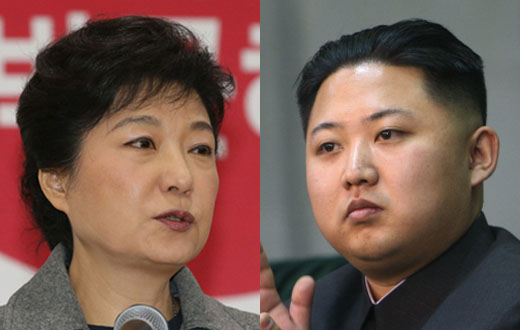
| ▲ South Korean President Park Geun-hye(left) and North Korean leader Kim Jong Un ⓒYonhap news agency |
South Korea must reach out first with the "string of trust"
The joy of victorious win of the presidential race is short-lived as the new President Park has her hands full with serious challenges that she must tackle during her presidency. This is important and critical turning point for the new government in the midst of current period of relentless crisis, and tough diplomatic and security environments. Stuck between the competition between the two giants United States and China, and expansion of hegemony and the rightward shift of China and Japan, it presents difficult challenge ahead to promote peace and security in the Republic of Korea. Kim Jong Un's North Korea is still unpredictable and the peace on the Korean peninsula is still volatile as ever.
The last 5-year of Lee Myung-bak administration has weakened the diplomatic position of South Korea and the intervention and the involvement in the Korean peninsular affairs has diminished as well as its influence with North Korea. President Lee was incompetent in his ability in establishing security and peace on the peninsula. Lee administration lost ownership of the situation and has become a spectator as it could only watch from the distance from its complete failure in diplomacy and security policies. This was the consequence of the suspension of inter-Korean relations.
The current inter-Korean relations is at the verge of complete breakdown and the incumbent administration must set this issue as a top priority and explore ways to improve the relations between the North and South. To establish peace on the West Sea, deter further provocations from Pyongyang and build military trust, must all begin with normalization of relations. Resolving nuclear and long-range missile issues and promoting peace regime on the Korean peninsula must also start with improving relations. Managing Kim Jong Un's regime and taking on the role as the "peace facilitator of Northeast Asia" to alleviate tension between China and Japan is only possible when the relations between the North and South are improved.
The incumbent Park administration has put forth its timely 'Korean peninsula trust-building process' as its main platform. Like laying a brick on top of each other one at a time, mutual trust must be established gradually. Only when this is accomplished inter-Korean relations can be improved and peace on the Korean peninsula can be achieved.
However, trust cannot be built on words alone. Written pledges alone do not secure trust automatically. It must be accompanied by consistent and reliable volitions and efforts to promote trust. Lee Myung-bak's policy of Mutual Benefits and Common Prosperity was flawless on paper. However, it ended in disappointment where mutual benefit or prosperity couldn't even take a foot forward that resulted in only hostility and tension.
'The Korean peninsula trust-building process" still requires concession from North Korea as a precondition. In the Park's article in Foreign Affairs in 2011 she writes, "North must keep its agreements made with South Korea and the international community to establish a minimum level of trust," and also emphasized joint projects for enhanced economic cooperation and infrastructure assistance to North Korea can proceed only when some advancement is made in the inter-Korean relations and denuclearization talks. In other words, North Korea must made take the initial step for trust-building to take place.
In regards to the May 24 sanctions, it is nearly hopeless to expect trust building without proper apology from the North. As President Park stresses that 'we cannot pretend as if nothing happened,' clearly apology and confirmation that reoccurrence of similar incident will not occur must be guaranteed by the North for the May 24 sanctions to be lifted. Even for the resumption of Mount Kumgang tours, placing conditional obligations for North Korea's action will set the normalization process squeaky from the get go. This also applies to the nuclear and missile issues as well. The recent United Nations Security Council sanctions against North Korea was counteracted by North Korea's further recalcitrant response, substantiating that the first step toward the trust-building will not be an easy task.
For the normalization of inter-Korean relations, one must be ready to fight with the cantankerous North Korea. In that process, North Korea will not hesitate to make personal invectives and adopt harsh policy against the South. Even during Kim Dae-jung administration, tangible results of improved inter-Korean relations were observed two years after the launch of the new administration. In order to deal with a unique regime of North Korea and improve relations, trust-building initiatives should not only take place with vision alone but also demonstrate consistency in commitment and action for reconciliation and cooperation even during the worst times of confrontation and unforeseen events. To build trust, rather than wait for North Korea to act first, President Park should offer her hand first to North Korea in order to be linked in trust. It will be difficult but the trust building must start from there.
| This article was published in ifes forum, on February 25, 2013. |




전체댓글 0