




The use of a preemptive attack as a response to the North's nuclear weapons has also been discussed. Yet, such preemptive attacks are controversial under international law and there is a high risk that such actions can routinise war crisis on the Korean peninsula. On the other hand, some people argue that Korea needs to establish a missile defense system through collaborations with the United States. Nevertheless, the effectiveness of such technologies are unproven with clear negative implications such as heavy economic burdens, increased military spending, and strained relation with China.
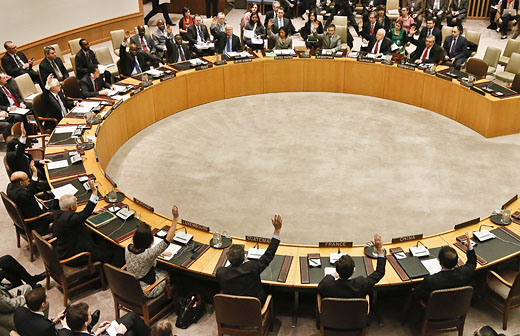
|
| ▲Security Council members vote for tough new sanctions against North Korea for its latest nuclear test, during a meeting at U.N. headquarters Thursday, March 7, 2013. ⓒAP |
Then, what are we supposed to do with North Korea's nuclear weapons program? Above all, we must avoid irrational approaches and analyze the current situation objectively. There is a slim chance that by acquiring nuclear weapons, Pyongyang can maintain military superiority over the ROK-US alliance. For the past twenty years, South Korea has been allocating a large portion of its budget to military spending; amounting to ten times more than its northern neighbor. Moreover, South Korea's alliance with the United States which has nearly 8,000 nuclear weapons remains firm. In other words, the ROK-US alliance still has sufficient deterrence capacity against the North.
The fact that the North Korean leadership has chosen to develop nuclear weapons in order to insure its survival is largely accepted by strategists. It is thus unlikely that the regime will give the green light on its use before exhausting other possibilities. However, history has taught us that skirmishes have the potential to escalate into full-scale conflicts with devastating consequences. Such scenarios can certainly lead to the use of nuclear weapons. It is thus highly advisable that Seoul take concrete measures that lead to greater trust between the two sides alongside strengthening its deterrence capability.
Re-opening the channels for conversation and negotiations will undoubtedly be a major development towards peace. There needs to be a shift in our current approach towards North Korea whereby dismantlement of its nuclear installations, set as the precondition for future negotiations is removed. In order to prepare the atmosphere for greater mutual trust, there has to be a new approach devoid of the Cold War era philosophies.
Building greater trust between the two parties involved in the peace process is an essential step and can be improved by respecting the viewpoints from both sides. Referring to recent developments surrounding North Korea's launch of a rocket which carried one of its satellites into orbit, on one hand, Pyongyang claims its right under international charters to carry out research and developments in satellite technologies. While on the other hand, the international community fears such dual-use technologies can further enhance the North's missile program. A possible solution to this dilemma is to respect Pyongyang's right to develop its satellite related technologies in return for the North's concrete steps which will lead to the denuclearization of the Korean peninsula.
It is important to find some common ground. Suspension of new sanctions in return for the North's suspension of further nuclear tests and rocket launches is a good starting point. The so-called New York channel can be further exploited and countries such as China and Russia can be involved as arbitrators. Such compromises have the potential to significantly contribute to building trust and will be a stepping stone to further negotiations about more sensitive matters.
Lastly, Presidents Park Geun-hye and Barack Obama need to actively promote summit diplomacy with North Korea. In the 1980s, the United States and the Soviet Union came to the brink of a full scale nuclear war due an environment of extreme mutual distrust, Sharing over 70,000 nuclear warheads between them, an apocalyptic scenario loomed over the people. Yet, the Cold War ended in 1989 without a single gunfire. Such progress was made possible largely due to frequent meetings between Ronald Reagan and Mikhail Gorbachev. Ending the Cold War on the Korean peninsula can start from such summit meetings.
| This article was published in Peace Network on February 23, 2013 and Son Daekwon and Ali Shaker contributed to translating this article into English. |




전체댓글 0