




In this essay, I examine a number of questions regarding these leadership changes in the context of North Korea, where Kim Jong Un's tenure in power is still new and untested. How does the North Korean leadership perceive these changes and how they will affect relations among these countries and North Korea? Will the changes advance harmony or aggravate conflict? Concretely, what impact will the transitions have on North Korea's strategy of survival and development for the 21st century? What did North Korea gain or lose from its recent satellite rocket launch and nuclear test? What strategy and policies should North Korea adopt to minimize the possibility of conflict in the future? And what should the other parties to the Six-Party Talks do to protect and enhance their interests?
|
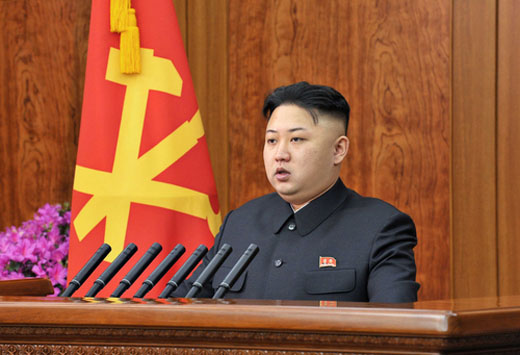
| ▲ North Korea leader Kim Jong Un ⓒYonhap news agency |
Waiting for the transitions
Kim Jong Un assumed the leadership of North Korea little more than a year ago, in December 2011. Since then, one can assume he has waited for the emergence of new leaders in Northeast Asia, as well as the possibility that Obama might not be re-elected, and pondered whether the future would lead to greater harmony or more conflict. Kim seemed to be most concerned about the South Korean and US elections. Potentially most problematic would be the outcome of South Korea's presidential ballot. It was interesting to observe that North Korea's official media rebuked the conservative Saenuri Party and its successful presidential candidate, Park Geun-hye, several times during the campaign. Park pledged a "trust process" toward the North, but her policy basically demanded that North Korea "move first" by abandoning its nuclear weapons program. Notably, Park did not mention during her campaign the need to terminate the state of war on the Korean Peninsula establish a peace regime.
Kim Jong Un was also concerned about US Republican presidential candidate Mitt Romney's campaign pledge to return to the belligerent North Korea policy of former President George W. Bush. Officials from the US National Security Council and the CIA made secret visits to Pyongyang in April and August 2012, allegedly demanding that North Korea not make any further provocations such as nuclear tests, satellite rocket launches or long-range missile tests during the US presidential campaign, according to numerous news reports citing unnamed US officials. What was supposedly promised in return was engagement with North Korea if Obama were re-elected.
With all these hopes, pledges and concerns in mind, Kim Jong Un appears to have anticipated that greater harmony would follow the leadership changes, and this would be in the North's interest. Why would harmony be more beneficial for North Korea than conflict? For starters, he viewed China as a steadfast ally and traditional friend, while he discounted the influence of Japan, because unlike China and the US, Japan isn't a rule setter in Northeast Asian relations. Moreover, Park's candidacy was viewed as partially encouraging because she distanced herself from the hard-line policies of her predecessor, Lee Myung-bak, and pledged to pursue a "trust process" and the provision of humanitarian aid to the North. Washington, meanwhile, appeared poised to be more conciliatory during a second Obama administration.
To choose Harmony or Conflict?
Enhanced harmony among the region's key countries could provide North Korea with a favorable environment to pursue its strategy of survival and development for the 21st century with help from the international community. In contrast, aggravated conflicts of interest among key players — particularly between the US and China and between North and South Korea — would create an environment where the North would find it difficult to seek co-operation and assistance from the outside to promote its economic development.
In short, good relations between the US and China and between the two Korea are critical for the success of North Korea's strategy. When China and the US — the key allies respectively of North and South Korea — work together to pursue the common goal of peace and security on the Korean Peninsula, progress becomes possible, because China and the US ultimately set the international order in East Asia.
For example, when US President Bill Clinton sought the denuclearization of the Korean Peninsula as a shared goal with China in the 1990s, he found a solution to the North Korean nuclear crisis. But when US President George W. Bush sought regime change in North Korea in the 2000s as a solution to the nuclear issue, he failed because China did not share that goal, particularly when the international order in East Asia appeared to be shaping up along the lines of a US-China rivalry.
China decided its current policy line toward North Korea in mid-July 2009, after Pyongyang's second nuclear test and the imposition of sanctions against North Korea by United Nations Security Council (UNSC) Resolution 1874. China was seriously concerned about the stability of North Korea, considering Kim Jong Il's failing health, and about its reduced influence over the North due to resentment that China had supported the UNSC resolution. In an effort to deny the US any strategic benefit, the Chinese leadership made it clear that the stability and survival of the North Korean regime was a top priority. Thus, the July 2009 decision clearly decoupled the nuclear issue from China's support for the stability and security of the North Korean regime.
In contrast to Bush, Obama has not sought the collapse of North Korea, but he has supported punishing sanctions. China, for its part, has repeatedly opposed sanctions that might threaten the stability of North Korea. This conflict of interests between the US and China has allowed North Korea breathing room to strengthen its nuclear, rocket and long-range missile capabilities. But its recent decision to launch a satellite rocket and test a third nuclear device has done enormous harm to its strategy of survival and development.
In an eye-catching development, China's new president, Xi Jinping, has recently demonstrated his own distinctive approach to Security Council actions against North Korea. Soon after he was formally named for the office, he was faced with North Korea's December 2012 satellite rocket launch. He decided to support Obama's effort to seek a UN Security Council resolution against the latest rocket launch, rather than a weaker "presidential statement" by the council. In the recent past, China has agreed only to presidential statements, not resolutions, against North Korean rocket launches, whereas it has agreed to resolutions against North Korea's nuclear tests. Xi appears keen to develop a good relationship with Obama as his era begins. He also appreciates the possible leverage the US has over Japan on the Diaoyu/Senkaku islands dispute at a time when he does not want tensions with Japan to escalate into a military conflict.
.JPG)
|
| ▲ Security Council members vote for tough new sanctions against North Korea, during a meeting at U.N. headquarters, January 22, 2013. ⓒAP |
Inter-Korean relations can also exert serious influence on the success or failure of North Korea's strategy of survival and development. Since the collapse of the Soviet Union, North Korea has wanted to enhance stability by improving inter-Korean relations, ultimately hoping to achieve peaceful coexistence and co-prosperity. North Korea must have thought that it was on that path during the presidencies of Kim Dae-jung and Roh Moo-hyun, but Lee Myung-bak reversed the trend during his administration.
Deep distrust and tension between the two Koreas resulted in the sinking of the South Korean corvette Cheonan; the shelling of Yeonpyeong Island by the North, both in 2010; and the suspension of a range of inter-Korean exchanges, including humanitarian aid to the North. The specter of further conflict or even war has hovered over the Korean people ever since, and the Koreas have not held a single round of ministerial-level talks, let alone an inter-Korean summit, during the last five years. This disastrous situation has had a severe impact on North Korea's efforts to implement its strategy of survival and development.
Weighing Gains and Losses
But if former South Korean President Lee can be held responsible for the drastic deterioration in inter-Korean relations in recent years, the latest downward spiral sits squarely with Kim Jong Un's decision to launch a satellite rocket and test a third nuclear device. In this respect, North Korea is largely responsible for tipping the balance toward conflict, not harmony, among the nations with new leaders at the helm.
Given that Kim Jong Un's development strategy would clearly benefit more from harmony rather than conflict, it is difficult to fathom why he would provoke Northeast Asia's new leaders in this way. To be sure, one might have foreseen a satellite rocket launch before the end of 2012 as a powerful way of commemorating the 100th anniversary of Kim Il Sung's birth, but adding a third nuclear test in February inflicted tremendous damage, at least for the immediate future.
What did North Korea gain and lose from these provocative actions? It appears to have gained de facto status as a nuclear-weapons state, meaning it can now be perceived as being well on the way to possessing a nuclear deterrent against external military threats. In addition, Kim himself appears to have personally benefited from this "high level" nuclear test, because it burnished his image domestically — and perhaps internationally — as a strong-minded leader despite his young age.
As for losses, North Korea's actions have alienated precisely the countries whose assistance could best help it succeed — South Korea, China, Japan and the US. In doing so, Kim has for the time being forfeited the opportunity to "restart" co-operative relations with new leaders who may have been willing to engage North Korea. That, in turn, has seriously imperiled the strategy he and his predecessors have adopted to develop the country economically in the 21st century.
What options and policies should North Korea adopt to return to greater harmony? First, Kim will have to find a path that makes his development strategy possible, and that entails persuading the US to accept peaceful coexistence with North Korea. Also, Kim must co-operate with the Washington to end the state of war on the Korean Peninsula and transform the armistice into a permanent peace. He also needs to promote reconciliation and co-operation with Seoul and mobilize international co-operation and support so that he can improve the living standards of North Koreans and strengthen the legitimacy of his rule by building an "economically strong state." But the rocket launch and nuclear test cost him all of these opportunities, at least for the foreseeable future.
Engagement, Not Hostility
What should South Korea and other countries do to promote harmony and peace and to protect and advance their interests? With a power shift taking place, South Korea is seeking good relations with both the US and China. Against this backdrop, one of the undesirable scenarios for South Korea is being forced to take sides because of a decision to confront North Korea or due to international pressure, such as being forced to co-operate with the US in punishing North Korea.
When South Korea promoted reconciliation and co-operation with North Korea, as it did under President Kim Dae-jung's "sunshine policy," it had the support of both the US and China, which saw that as encouraging a less confrontational and trouble-making North Korea.
On the other hand, when South Korea pursued a confrontational policy in line with the US policy of seeking the collapse of North Korea, it invariably created tension in the US-China and China-South Korea relationships. This split inevitably heightened tensions on the Korean Peninsula and in East Asia. This gave North Korea a good excuse to strengthen its nuclear deterrent, which deprived South Korea of the opportunity to explore a peace settlement in Korea.
With such lessons in mind, what can be done to achieve the denuclearization of North Korea, a peace settlement, national reconciliation and reunification? Basically, the success or failure of past efforts to achieve these goals has been the product of the interaction of the parties involved. Whatever distrust the nations involved have toward one another should be understood, like it or not, as a mutually created problem. Therefore, all countries involved in Korean and East Asian affairs must co-operate to resolve conflict and improve prospects for harmony and peace by abandoning "the crusading spirit" in diplomacy, and be "willing to compromise on all issues that are not vital," as Hans Morgenthau advised more than six decades ago in his classic book, Politics Among Nations. "Look at the political scene from the point of view of other nations," was part of Morgenthau's still-wise counsel.
Why not opt for a "win-win" strategy for all involved? Why not engage North Korea aggressively so that it can focus more on reform and opening in a less threatening environment, thereby moving once more toward a comprehensive deal? Resolving the North Korean nuclear issue won't be easy, since North Korea has now effectively become a nuclear-weapons state. It is not an impossible thing to achieve, however, if and only if South Korea and the other nations involved are ready to persuade North Korea to denuclearize itself by abandoning hostile policies toward Pyongyang and transforming the armistice into a permanent peace regime as a quid pro quo for denuclearization.
| This article was published in Global Asia on March of 2013. |




전체댓글 0